
Surface Analytics is a provider of advanced materials characterization, with expertise in Secondary Ion Mass Spectrometry (SIMS). Services include support of customers in industry and academia worldwide, helping them solve complex analytical challenges with state-of-the-art instrumentation and a customer-oriented approach. Beyond high-quality SIMS analysis, consulting is provided to help you get the most from your data. Whatever your question, our priority is to support the development of your ideas.

Secondary Ion image of the company logo after Bi DC rastering over a Pt/Si stack - Pt- (green) and Si- (blue).

Surface spectrum
A surface spectrum is a mass spectrum (m/z vs intensity) of secondary ions emitted from the top 1-2 nm of a sample under a low-dose pulsed ion beam. It acts as a chemical fingerprint of the outmost surface.

Depth profile
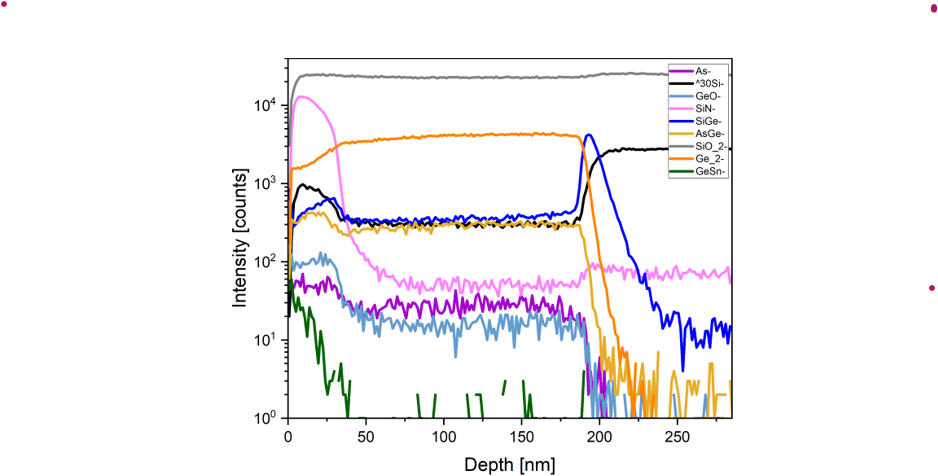
A depth profile plots secondary ion intensity vs sputter time/depth, as a sputter beam alternatively erodes the multilayer while a pulsed analysis beam probe each freshly exposed surface. It reveals each layer's composition, thickness and interface sharpness.
Ion image and 3D
Ion imaging rasters a focused beam across the surface, recording a full mass spectrum per pixel to map the lateral distribution of any ion. 3D analysis alternates imaging with sputtering, stacking the 2D maps linto a volumetric chemical reconstruction.

Time-of-Flight Secondary Ion Mass Spectrometry
Time-of-Flight Secondary Ion Mass Spectrometry (ToF-SIMS) is a highly sensitive technique for the chemical characterization of surfaces, interfaces and thin films. A pulsed primary ion beam strikes the sample and causes the emission of atoms and molecular fragments from the outermost one to two nanometers. The fraction that leaves the surface as secondary ions is extracted into a flight tube, where lighter ions reach the detector before heavier ones. The arrival time gives the mass with high precision, so a single measurement provides elemental and molecular information from all species at the surface, in both positive and negative polarity.
ToF-SIMS offers three complementary types of information. Mass spectra identify the elements, molecules and fragments present on a surface. Chemical images show how these species are distributed laterally, with sub-micron detail. Depth profiles reveal how composition evolves through layers and across interfaces. Because the technique works on a wide range of materials, including metals, semiconductors, glass, ceramics, polymers and organic films, it is a versatile tool whenever the chemistry of a surface or interface matters.
The choice of analytical mode and ion source defines what an experiment can reveal. High mass resolution spectrometry, typically above 10,000 (m/Δm), separates closely spaced peaks and allows molecular species to be assigned from accurate mass. In imaging mode, burst or bunched operation gives sub-micron lateral resolution at the cost of some mass resolution. Depth profiling is performed in dual-beam mode, in which a sputter beam erodes the sample while a pulsed analysis beam probes the crater bottom. Low-energy Cs⁺ or O₂⁺ beams provide excellent depth resolution for inorganic materials and enhance electronegative or electropositive species respectively. Argon gas cluster ions (GCIB) sputter gently enough to preserve molecular information in organic materials, and bismuth cluster ions in the analysis beam give high molecular yields and fine spatial resolution. Combining imaging and depth profiling allows the chemical structure of a sample to be reconstructed in three dimensions.
Quantification in ToF-SIMS requires care. Secondary ion yields depend strongly on the chemical environment of the analysed species, so the technique is inherently semi-quantitative. Reliable quantitative results are obtained with matrix-matched reference materials and relative sensitivity factors, with detection limits in the ppm to sub-ppm range for many elements. In surface analysis, the primary ion dose is kept below approximately 10¹² ions/cm², so that the surface remains essentially undamaged during the measurement. Complex spectra and large imaging datasets can be evaluated with multivariate methods such as principal component analysis and multivariate curve resolution.
Advanced SIMS analysis
Self-Focusing SIMS: advanced SIMS for nanoscale structures

As microelectronic devices shrink to tens of nanometers, the features of interest become much smaller than the beam spot and lateral resolution of conventional SIMS. Self-Focusing SIMS (SF-SIMS) approach addresses this issue.
SF-SIMS exploits the physics of cluster ion formation. A cluster ion (AB) can only form if its constituent atoms originate from the same collision cascade, in very close proximity (<1 nm). By selecting a cluster that combines elements found only in the region of interest, the analytical information is "self-focused" to that region, even when the primary ion beam is much larger than the feature itself. This makes it possible to determine the composition of nanoscale structures such as narrow trenches (down to 10 nm), thin films or confined volumes, without needing a probe smaller than the feature. Combined with depth profiling, the self-focused cluster signal can be followed as a function of sputter depth. This gives the composition profile (bulk composition, dopant level, ...) of a layer inside a confined structure. The approach does not require any special sample preparation. One limitation is that SF-SIMS relies on higher-mass cluster ions, so high mass resolution is often needed to avoid interferences. This motivates the use of high-resolution analyzers such as Orbitrap-SIMS.
Surface Analytics has full expertise in the advanced SF-SIMS approach, from experimental design and cluster-ion selection to data interpretation and quantification. Surface Analytics supports customers who need reliable composition analysis of confined volumes and advanced materials, where conventional SIMS reaches its limits.
Areas of Applications
Surface Analytics delivers expert materials characterization via SIMS and scientific & technical consultancy to the industry and academia.

Semiconductor

Research Institutes & Academia

Energy & Environment

Materials Science

Automotive

Chemicals

Electronics

Steel & Metals

Life Science & Pharma

Glass
Read More
-
Vickerman J. C., Briggs D. (eds.), "ToF-SIMS: Materials Analysis by Mass Spectrometry", 2nd ed., IM Publications (2013).
-
Benninghoven A., Rüdenauer F. G., & Werner H. W. , "Secondary Ion Mass Spectrometry: Basic Concepts, Instrumental Aspects, Applications and Trends", John Wiley & Sons (1987).
-
Wilson R. G., Stevie F. A. & Magee C. W., "Secondary Ion Mass Spectrometry: A Practical Handbook for Depth Profiling and Bulk Impurity Analysis", Wiley (1989).
-
Mahoney C. M., "Cluster Secondary Ion Mass Spectrometry: Principles and Applications", Wiley (2013).
-
Franquet A. et al., “Self Focusing SIMS: Probing thin film composition in very confined volumes”, Applied Surface Science, 365, 143–152 (2016).
-
Franquet A. et al., “Composition analysis of III–V materials grown in nanostructures: The self-focusing-SIMS approach”, Journal of Vacuum Science & Technology B, 34, 03F125 (2016).
-
Franquet A. et al., “Orbitrap™-SIMS analysis of advanced semiconductor inorganic structures”, Vacuum, 202, 111182 (2022).
-
Tilmann R. et al., "Identification of ubiquitously present polymeric adlayers on 2D transition metal dichalcogenides", ACS nano 17 (11), 10617 (2023).
-
Tilmann R. et al., “Orbitrap™-SIMS for accurate quantification of arsenic in SiGe across blanket and fin-type geometries”, Journal of Vacuum Science & Technology A 44 (2026).